

stfc.ir / jashnvareh
Your organisation's entire attack surface, in one living graph
From the first forgotten subdomain to the complete attack chain: the platform discovers your assets, runs more than 500 security tests against them, links the findings together and delivers a documented, reproducible, board-ready report: work that is conventionally split across several teams, tools and contractors.
- Setup to first run
- 15minutes
- Passive assessment
- 20minutes
- Active, in-depth assessment
- 90minutes
- Security tests and checks per assessment
- 500+tests
- Coverage areas, from DNS to mobile apps
- 12domains
- Technical and executive report
- 70+pages
Not a tool. A complete assessment apparatus.
Common tools each show one piece of the picture: one finds subdomains, another scans ports, a third builds reports. The platform brings all of these layers into a single core and delivers something their sum does not: a connected picture of how an adversary sees your organisation.
A graph, not a list
Every domain, subdomain, IP, certificate, service and finding is a node in the asset graph. Relationships are visible, change history is recorded, and ownership confidence is stated for each asset.
Findings are chained together
Separate weaknesses become multi-stage attack paths mapped to MITRE ATT&CK, together with the blind spots your monitoring team is likely to miss.
No claim without evidence
Every finding carries an evidence class and a reproducible command. A test that failed or was blocked is recorded as “not checked”, never as “secure”.
Sovereign and independent
It runs on your own infrastructure, even in an isolated network. Data never leaves the organisation, and every network request is written to a hash-chained journal.
What your organisation sees in the platform
The images below are from the real Jashnvareh platform interface.
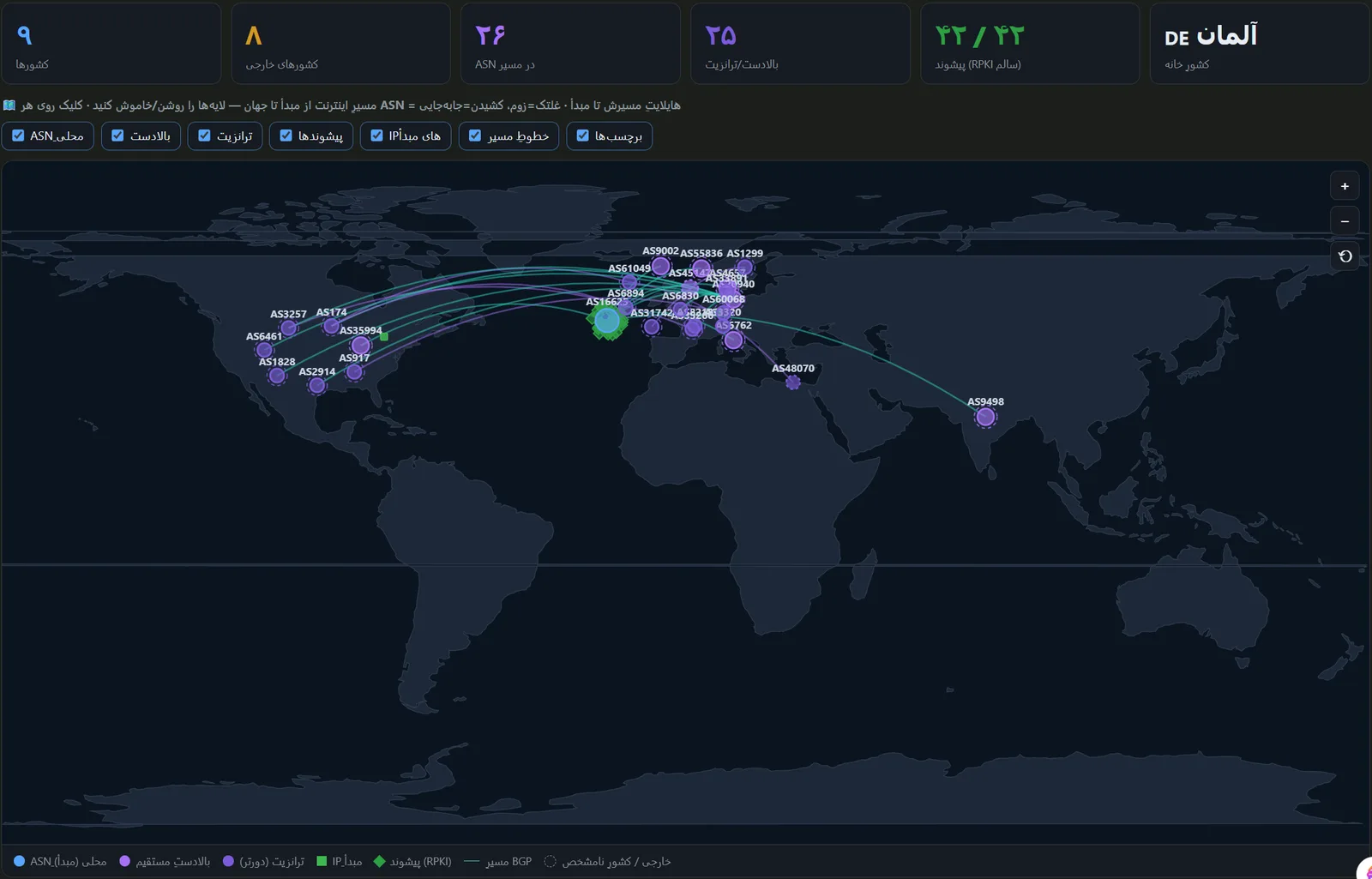
Global attack surface map
The network paths between the internet and your assets, with upstream providers, transit and RPKI status.
Asset relationship graph
Every domain, IP, network prefix, ASN and provider in one view, with the links between them.
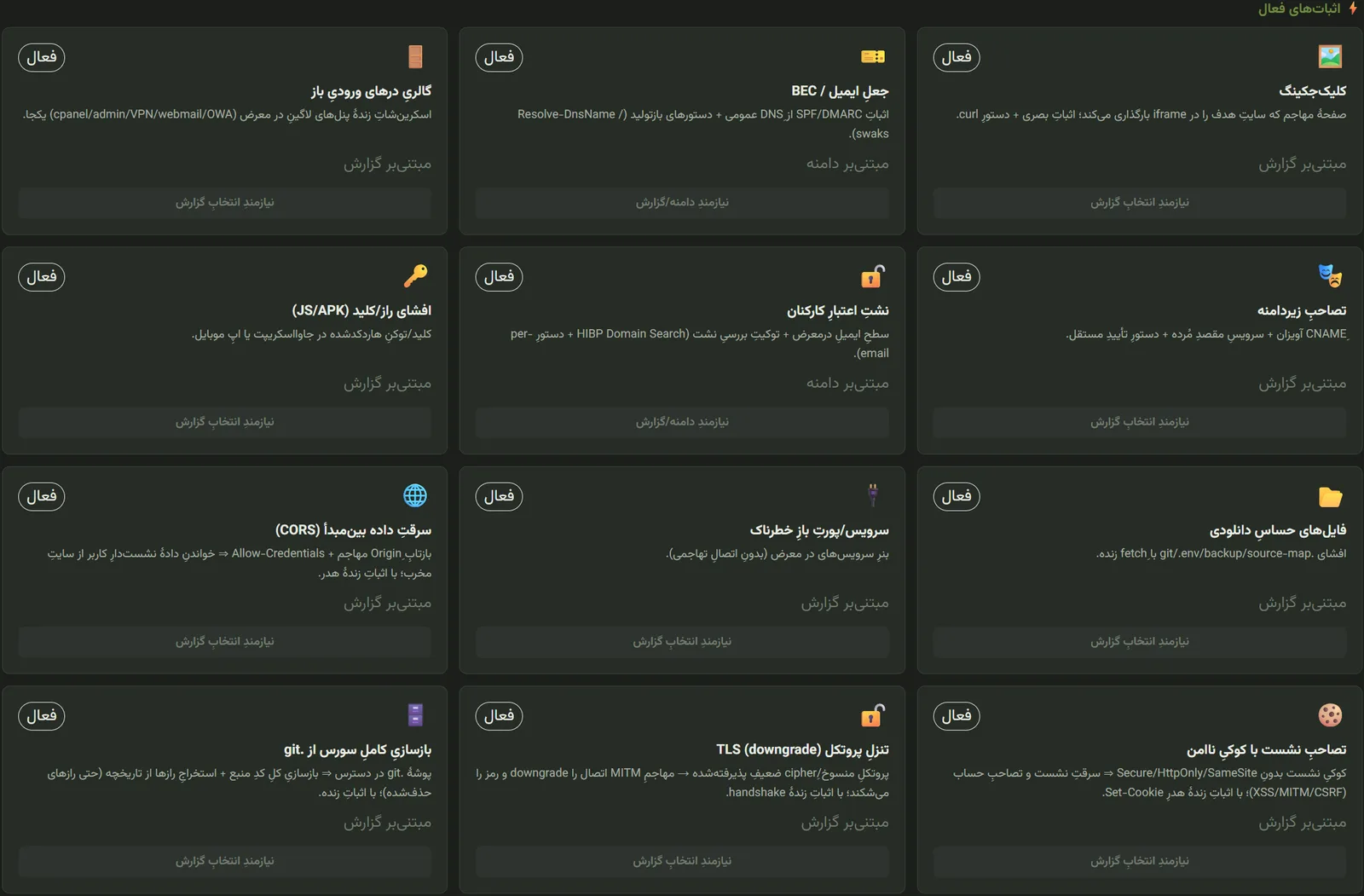
Proof-of-concept centre
Every weakness comes with a safe, reproducible proof your team can run.
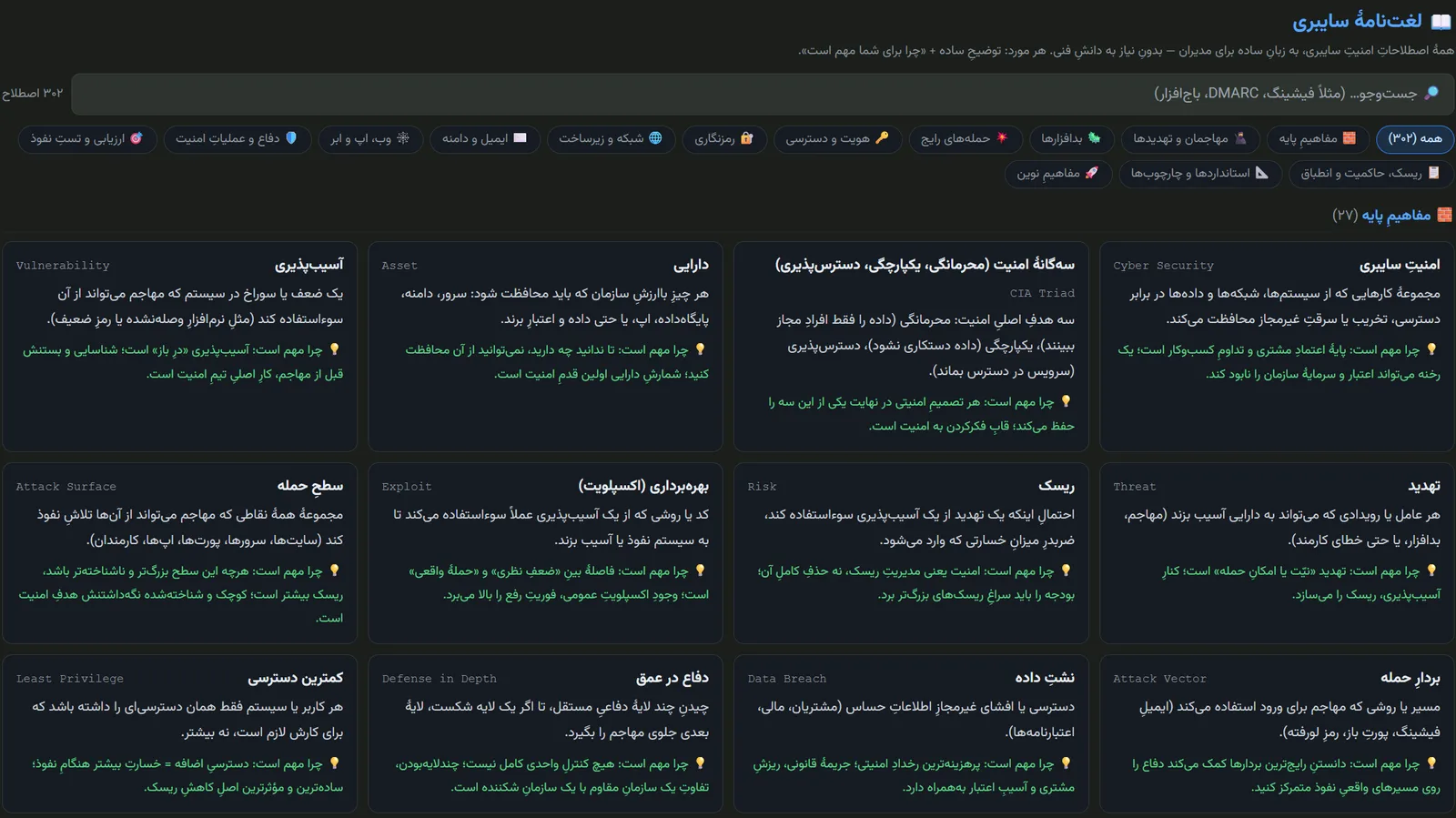
Cybersecurity glossary
More than 300 security terms in plain language, for executives and decision-makers.
More than 500 tests across twelve domains
This is not a marketing list. These are the areas the platform actually examines in each assessment.
Asset & subdomain discovery
- Subdomain enumeration from active and passive sources
- Live Certificate Transparency monitoring
- Archive and Wayback history
- Related assets via favicon fingerprints and tracker IDs
- Cloud assets and shadow IT
- Ownership confidence for every asset
Infrastructure graph & routing
- ASN and network prefix mapping
- BGP route health and RPKI status
- CDN, hosting and provider identification
- Geographic footprint and topology
- Dependency concentration and single points of failure
- Network boundary map
DNS & domains
- DNS intelligence and sensitive records
- Subdomain takeover verification
- Dangling CNAMEs
- Registration and WHOIS data
- Look-alike and phishing domain watch
Web & applications
- Security headers and CSP
- CORS, CSRF and clickjacking
- XSS, SQL injection, LFI, SSTI, SSRF
- Host header and CRLF injection
- Exposed config files, backups and repositories
- Admin panels and CMS
APIs
- Swagger / OpenAPI inventory
- GraphQL reconnaissance
- Object- and function-level access control (BOLA / BFLA)
- Hidden parameter discovery
- Unauthenticated access
Authentication & sessions
- JWT configuration
- Multi-factor authentication posture
- Brute-force resistance
- Cookie and session security attributes
- Post-login assessment with test accounts
TLS & cryptography
- Deep cipher and protocol audit
- Chain of trust and certificate expiry
- Known TLS vulnerabilities
- SAN exposure radius
Email & anti-spoofing
- SPF, DKIM and DMARC
- Practical proof of sender spoofing
- Phishing and BEC risk
- Sending domain health
Infrastructure & services
- Open port and service audit
- Version and technology fingerprinting
- WAF detection and behaviour
- Age and support status of technologies in use
- Availability watch
Data leaks & supply chain
- Secrets and keys in JavaScript files
- Exposure in public breach incidents
- Exposed DevOps and CI/CD tooling
- Open cloud buckets and services
- Third-party dependencies and scripts
Mobile applications
- Static analysis of APK / XAPK
- Hard-coded secrets and endpoints extracted
- High-risk permissions
- Extended analysis with MobSF
Payments & banking
- Payment gateway audit
- Open banking APIs
- Business logic and payment abuse
- Personal identifier discovery (national ID, IBAN, card)
- Banking WAF identification
From finding to decision
A long list of vulnerabilities does not help a decision-maker. The platform turns findings into priorities, scenarios and action.
Vulnerability intelligence
Each technology version is matched against known CVEs and prioritised with the actively exploited list (CISA KEV) and exploitation probability (EPSS).
Attack chains
Several weaknesses combined into ranked intrusion paths, separating what was observed from what is a likely consequence.
Adversary simulation
Adversary profiles and a step-by-step attack plan built on that organisation's real findings, not generic scenarios.
Detection gap
Shows which adversary tactics are likely to stay hidden from your monitoring team (SOC).
Risk & remediation engine
Ranking by business impact, tiered remediation priority, and a fix for every finding.
Retest & comparison
Each finding can be retested individually after a fix, and two assessment rounds are shown side by side.
Continuous monitoring (CTEM)
Scheduled assessments, a log of attack surface change events, and webhook notifications.
Contractor scorecards
Assets attributed to suppliers, a security posture score, and comparative reports across contractors.
The right depth and duration for every scenario
Depending on your needs and the authorisations in place, an assessment runs at one of three levels.
Passive
Based on observation and publicly available evidence, with no direct interaction or exploitation. Safe to run against any asset, even without prior coordination.
Under 20 minutes
Active
Deeper, more intrusive tests in defined scenarios, with rate control and safe policies that prevent disruption to the target service.
About 90 minutes
Deep / attack simulation
Attack chain analysis, simulation of realistic adversary scenarios, and assessment of the combined business impact of several weaknesses.
Depends on scope
Confirmed evidence always stays separate from hypothesis
The platform never presents an unverified hypothesis as a proven vulnerability. Every finding carries a stated confidence level and a reproducible command (curl, openssl, jadx), so any specialist can verify it independently.
- Finding confirmed by direct evidence
- Finding that needs manual validation
- Hypothesis proposed for the technical team to review
$ curl -sI https://target/admin | head -1
$ openssl s_client -connect target:443 | openssl x509 -noout -enddate
A report executives and engineers both read
One assessment, several outputs for different audiences.
Executive summary
The risk picture in decision-makers' language, with action priorities and estimated impact.
Technical report
Detail for every finding: evidence, reproduction command and remediation for the technical team.
Confidential, signed report
PDF output with a digital signature that guarantees authenticity and integrity.
Mapping to standards
Findings linked to PCI-DSS, NIST, ISO 27001 and national requirements.
Visual evidence
Screenshots of discovered assets, embedded in the report.
Live dashboard
Asset fleet view, exposure map and risk trend over time.
Powerful, but under control
A system that tests attack surfaces must itself be trustworthy and auditable.
Authorisation before action
No active test runs without a recorded authorisation for the target.
Network guard
Fail-closed egress control: the platform talks only to authorised targets.
Pressure control
Request-rate profiles that prevent disruption to the target service.
Tamper-evident journal
Every request and decision recorded with a timestamp and hash chain.
Transparent identity
The platform identifies itself in every request. It does not hide.
Isolated network mode
Deployable in environments with no internet connection.
Overseeing the cybersecurity overseers
Companies and contractors responsible for protecting infrastructure or providing IT services to sensitive organisations can themselves be exposed to misconfigurations and security flaws. The platform enables an independent assessment that does not rely on that contractor's own reports. Observing a weakness is not proof of compromise in itself, but it is an early signal for independent validation and corrective action.
Technological independence and data stewardship
The platform was developed in-house, and its architecture allows deployment in line with your organisational policies, defined access boundaries and full control of data, with no dependence on third-party processing infrastructure.
Short answers to common questions
What is the Jashnvareh platform?
The Jashnvareh platform is an integrated External Attack Surface Management (EASM) system developed by STFC. It discovers an organisation's internet-facing assets, runs more than 500 security tests against them, links the findings into attack paths, and delivers a documented, reproducible report.
How long does an assessment take?
Setup takes about 15 minutes, a passive assessment under 20 minutes, and an active assessment about 90 minutes. A deep assessment with attack simulation depends on the scope.
Is it safe to run an assessment against production services?
A passive assessment relies only on observation and public evidence, with no direct interaction or exploitation. Active tests run only after an authorisation for the target is recorded, and under request-rate control so the service is not disrupted.
Where is our data kept?
The platform runs on your own infrastructure and can be deployed in an isolated network. Data does not leave the organisation, and there is no dependence on third-party processing infrastructure.
How is it different from a vulnerability scanner?
A scanner returns a list of findings. The platform connects assets in a graph, turns separate weaknesses into attack chains, keeps confirmed evidence apart from hypothesis, and gives a reproducible command for every finding.

See the platform on a sample domain
In a short session, watch asset discovery, assessment and report output run live.